It has been a while since I published a book and a few years since I was doing it regularly. Although I have been writing the whole time, it just hasn’t been coming together. I couldn’t tell you how many half-finished manuscripts and abandoned drafts are scattered around my office.
I jumped from tool to tool. Some stuff is in notebooks, buried on the shelves amongst stacks of other half-filled books. There are things written in Scrivener, in Markdown, in Google Docs.
It’s easy for me to look back now and see that it’s all a symptom of other stuff going on in my life, but it felt like the cause at the time and there’s every chance I’m not over it yet. I feel like I’ve settled on a system now, but maybe in a months time this will just be another failed project to throw in with the rest. Most of the time we’re pretty crap at seeing what’s really going on while it’s happening.
But right now I’ve got a system and although it might be temporary, there’s one thing about it I’m fairly sure is going to stick around: going slower.
When I started publishing thirteen years ago, I went fast. At my peak I was publishing a book a month while holding down a full time job and all the other stuff I had going on. And it was fun and exciting but it was totally unsustainable. Even before other stuff happened, I was dropping projects half done and the pace of publishing was slowing.
That’s the biggest change right now. I don’t feel like I’m in a race anymore and I’m optimising for enjoyment. Which I think come out in the writing.
I’ve always felt more comfortable writing by hand. The slower pace forces me to think more about what I’m writing. The dread of the blank page and blinking cursor just doesn’t exist when I’ve got a pen in my hand. Everything feels more relaxed.
There is a lot of flexibility with my new system. My current WIP started in a notebook, now I’m working on the same story in GoodNotes. Neither contains the full draft but it doesn’t matter because at the end of each writing block, I take what I’ve written and convert it to plain text using Claude, then copy and paste that into Obsidian.
That text file in Obsidian is the source of truth. It doesn’t actually matter whether I use a notebook, GoodNotes, or scraps of paper, as long as it ends up in that file. In theory, if I decide I do want to start writing on a computer again, I can do it without missing a beat.
It’s slower, but that doesn’t matter because I find it much easier to be consistent. And it’s better for me to write 800 words every day than it is to write 3,000 words one day, 2,000 words the next, and then nothing for the rest of the week.
The next step is figuring out the editing process because I want to do that with the same approach. Slow and consistent, not quick and sporadic.
AI is a thing I’m still trying to figure out. I’ve gone from curious to skeptical to loathing. Right now I’m not sure where I stand because on the one hand it seems inevitable, but on the other it is an ethical nightmare built from stolen data and consuming the worlds resources more quickly than any other technology ever has. Conflicted barely covers it.
But if I’m being honest, there is one thing I’ve started using it for and it does it better than any other tool I’ve ever used: OCR.
I’ve always loved the idea of hand writing books. In the past I have completed first drafts of stories on paper and although I enjoyed the process, I could never bring myself to take the next step and type the thing up for editing. So all those stories (not many, but a few) are still sitting in a drawer somewhere or, more likely, lost forever. But this is where AI comes in. I can take a photo of a page, ask it to convert it to text and it does, with something close to 100% accuracy.
It has opened up this whole new way of working for me and I’m still not sure how I feel about it, but I can’t argue with the results.
What I’ve been doing with my current story is writing in GoodNotes on my iPad, exporting the page as a picture, and pasting that into Claude for the OCR conversion. So I now have close to 8,000 words of editable text that I can start editing without having to type anything.
Doing it this way does lose one of the advantages of writing by hand: the natural second draft you automatically create when typing it up, but I’ve never really gotten to that stage so I’m not losing anything. And I think my writing is better when I work by hand than typing, so I’m already better off.
I am conflicted though and maybe there are some less ethically questionable options out there. But this is the first time I’ve seen how AI can aid me creatively without actually having any input in the process. It’s not writing anything for me, it’s taking words I have already written and changing the format.
There is absolutely no way I will ever let AI create words for me, but this is a useful little service it can provide.
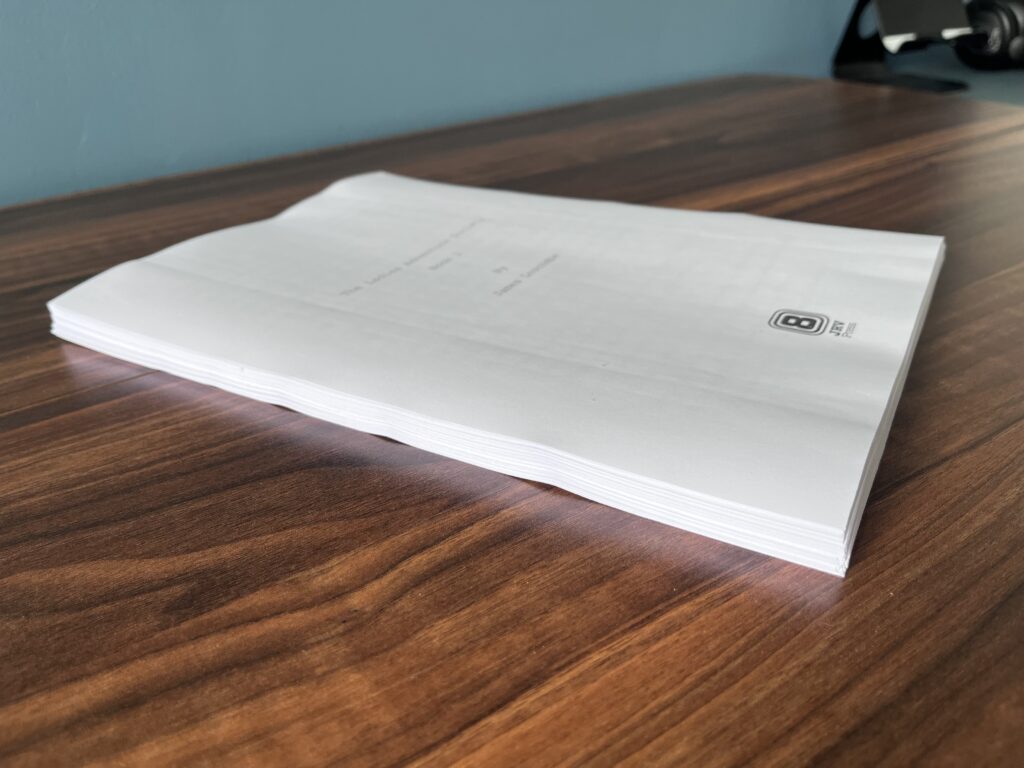
I like to print out the first draft of my manuscripts as I am going, so that I can see the progress that I am making. It gives me a better feeling of achievement than seeing the word count on a computer screen does.
Today I finished the seventh chapter of The Ladies Adventure Society, which is about a quarter of the way through the story. At 25,000 words, that means I’m looking at a first draft of 100,000 words, which seems about right.
This morning I found myself starting to doubt the story I’m working on. I began asking myself whether it was really the best thing I could be doing, whether I wanted to spend so much time writing it.
Resistance is part of any project worth taking on and I am used to coming up against it. Sometimes I win the battle and sometimes I lose. Quite often, the battles that I lose, end up being projects that I look back on and wish I had finished.
“Resistance in my experience always kicks in when you’re trying to move from a lower level to a higher level or to identify with a braver part of yourself or your higher nature. So it’s that negative repelling force. It’s kind of the dragon that we have to slay every day if we’re artists or entrepreneurs.” – Steven Pressfield
Even now there are stories sitting half-finished that I think I might return to one day but that I wish I had never abandoned. They are stories that I think would have been really good. Perhaps they were stories which could have pushed my skill to a new level.
So the question becomes; how is it best to handle resistance?
“Don’t prepare. Begin. Our enemy is not lack of preparation. The enemy is resistance, our chattering brain producing excuses. Start before you are ready.” – Steven Pressfield
Which is where I find myself now.
There is always the possibility that what I am working on isn’t worth persevering with, but I won’t know that until I have some perspective. The only thing I know for sure right now is that most of the projects I have abandoned would have been woth persevering with.
I don’t know if I’m ready to start yet, but maybe I should take the resistance I’m feeling as a sign that I should. There are reasons to wait, good one’s, but there might be better ones to start.
When I’m writing I like to have a list of names that I can pick and choose from as I’m going. It saves me having to stop and think of them while I’m in the flow. It also means that I don’t have to type “XX” or whatever to remind myself to add it in later.
I already have the names of the main characters in my upcoming story, but I needed some extras to choose from for characters that I don’t know about yet. This morning I put together a couple of lists, one for surnames, the other for first names.
A couple of invaluable resources for this process are:
I am planning to add more “quick tips” like this. There are a lot of good resources out there and I am always interested to find out what other people use.
When you encode an analogue music file to MP3, some loss of quality is unavoidable.* I believe that the same is true when you pick digital tools over analogue ones.
You may have picked up on my preference for notebooks and pens over computers and phones. In my mind this is more than a choice over which is more fun to use. I believe that using analogue tools leads to a better output.
There are, of course, benefits to using digital notebooks, but as I considered this over the weekend (writing into my pocket notebook) just because there are some benefits, doesn’t mean they make up for the disadvantages.
I want to be able to leave my phone behind for days at a time and that won’t feel possible if I’m using it for notes. So, despite the many advantages of using my phone as a notebooks, that one disadvantage is enough to make it a no go.
There are other disadvantages, but that was the big one at the weekend. And it’s an important one. Being able to leave my phone behind makes up for the occasional inconvenience of taking out a paper notebook, for those times when it’s not possible so I miss something. It makes up for a hell of a lot and when you add it to the other advantages (quality, peace of mind, memory improvements) then it just doesn’t make sense for me to switch.
The problem with a lot of digital technologies is that by using them I would be encoding for loss. I know from the start that they aren’t as good as analogue equivalents, so by using them I am saying that quality is less important that convenience. As I mention in Compromises that is occasionally a compromise that I am willing to make, but not always, in fact, not even often.
*Yes, I understand that there are “lossless” formats such as FLAAC, but I would argue that even when using those formats a certain amount of loss happens by not having a physical representation on the music such as a CD or record. In my experience, listening to music goes beyond the sounds that you hear when you press play. At its best it is a tactile experience.